

Practical overview
Dubai's digital-service direction is making customers less tolerant of repeated forms and slow handovers. Businesses feel the same pressure: leads, payments, bookings, documents and reports need to move between systems cleanly.
API-first architecture is the practical answer when your team is spending too much time copying data between tools.
Why API-First Matters in Dubai Now
Dubai's public-sector digital direction is moving toward unified, proactive and connected services. Businesses do not have to copy government architecture, but they should learn from the principle: customers expect fewer repeated forms, faster status updates and cleaner handover between channels.
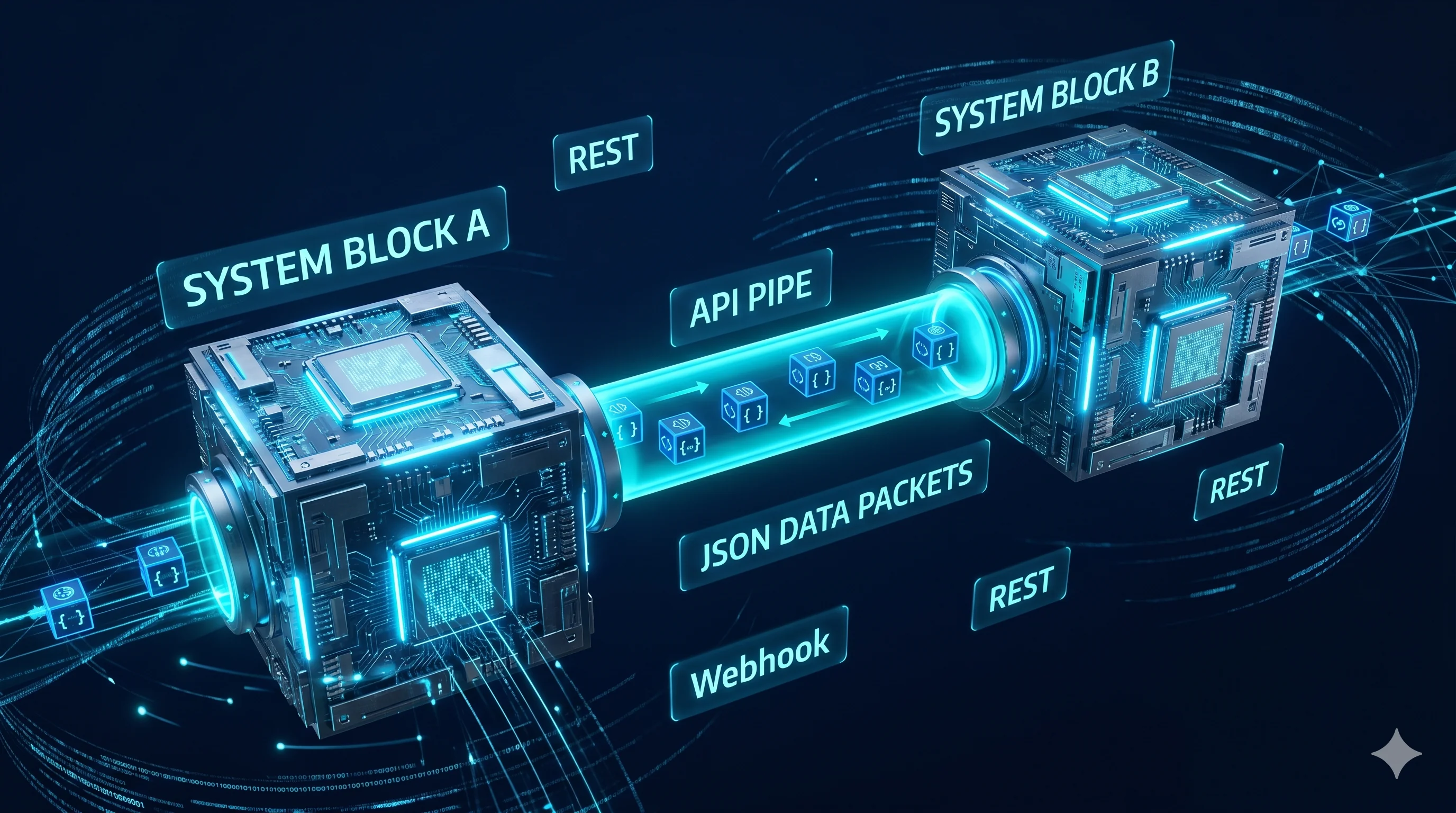
API-first means your systems are designed to talk to each other reliably. A website enquiry should become a CRM lead. A paid invoice should update the customer record. A booked appointment should trigger reminders. A support ticket should show past purchases. None of that should require copying and pasting.
The Integration Map Every SME Needs
Draw the path of a customer from first visit to payment and support. Most UAE SMEs discover six separate systems: website, WhatsApp, CRM, payment gateway, accounting software and spreadsheets. The goal is not to force everything into one tool. The goal is to decide which system owns each data point.
For example, the CRM owns lead status, the payment gateway owns payment confirmation, accounting owns invoices, and the website owns first capture. APIs move the important updates between them.
Build Middleware Before Replacing Everything
When systems do not connect, owners often think they need a full rebuild. Sometimes they only need middleware: a small custom layer that receives webhooks, transforms fields, validates data, retries failed requests and logs what happened. This can connect Shopify, Stripe, Telr, HubSpot, Zoho, Xero, QuickBooks or a custom Laravel app.
Middleware is not glamorous, but it is often the cheapest way to remove admin pain. It also gives the business control over data flow instead of depending on fragile plugin chains.
What a Good API Integration Includes
A serious integration includes authentication, webhook signature checks, retry logic, rate-limit handling, error alerts, field mapping, permission boundaries and an exception dashboard. Without these, the integration may look finished but silently drop data when a third-party API slows down.
For Dubai businesses, payment and invoice workflows deserve extra care. A failed sync can affect cash flow, customer trust and finance reporting. Build logs that non-developers can read.
Where to Start
Start with the most expensive manual handover. If staff spend hours every week moving website leads into CRM, fix that first. If payment status is the constant headache, connect payments to invoices. If management reports take a day to prepare, centralise analytics.
API-first is not a technology fashion. It is a way to make the business feel less scattered. The right first integration should save time every week and reduce mistakes immediately.
The Reliability Layer Nobody Sees
The public part of an integration is the happy path: a form submits, a payment succeeds, a CRM record updates. The valuable part is the reliability layer: retries, logs, alerts, permissions and fallback states when an external API fails.
That layer is what separates a serious integration from a demo. It lets a business owner trust the workflow during busy weeks, not just during launch.
Practical checklist
Map customer journey from first enquiry to payment and support.
Decide which platform owns each data field before connecting APIs.
Use webhooks for time-sensitive updates and polling only where webhooks are not reliable.
Add retry logic, error alerts and readable logs.
Protect API keys and separate staff permissions by role.
Start with the handover that wastes the most weekly staff time.
How to turn this into a real project decision
Start by writing the business problem in one line. For example: the website is slow, the Shopify product page is confusing, the WordPress site does not generate quality leads, or the Laravel dashboard cannot support the workflow anymore. A clear problem statement makes the technical decision easier.
Next, separate the requirement into user experience, backend logic, SEO, speed, integrations and content. This prevents the common mistake of redesigning a page when the real issue is data structure, plugin conflict, weak copy, poor mobile UX or missing automation.
For Dubai, UAE and international clients, the strongest web solution is usually the one that improves trust, reduces manual work, loads fast on mobile and gives visitors a clear reason to contact the business. That is the standard I use when planning Laravel, WordPress, Shopify, ecommerce, dashboard and SEO-focused work.
FAQs
What does API-first mean for a Dubai SME?
API-first means planning your website, CRM, payments, accounting and customer portal so they can exchange reliable data. It does not mean rebuilding everything; it means reducing manual handover and duplicated records.
When should a business build middleware?
Build middleware when plugins or native integrations are fragile, missing key fields, or unable to handle your approval and reporting rules. Middleware is often cheaper than replacing several working platforms.
Which systems should UAE businesses connect first?
Start with the most expensive manual step: website leads to CRM, payment status to invoices, ecommerce orders to fulfilment, bookings to reminders, or project status to client portals.
Ready to discuss this?
Send your website URL, platform, issue and goal — I'll reply with a practical direction within 4 hours. Free 20-min discovery call available.
Message on WhatsApp — Free 20-min callRelated service
Looking for hands-on help with this?
API Integration ServicesRelated services
Need help applying this to your project?

Anas Tanveer
Full-Stack Developer in Dubai with 7+ years in Laravel, WordPress, Shopify, business dashboards, APIs, and SEO-ready web systems.
View profile