
Why businesses need integration, not new software
There's a strong pull toward buying or building "one system to rule them all." It rarely pays off. Your Shopify or WooCommerce store is good at selling. Your CRM is good at relationships. Stripe or a UAE bank gateway is good at money movement. Replacing all three with a single custom platform means rebuilding capability you already own and pay for.
Integration takes a different position: keep the best-of-breed tools you already trust, and wire them together so data flows automatically. The benefits are immediate and measurable:
No double entry — an order placed online lands in your CRM, accounting, and shipping account without anyone retyping it.
Fewer errors — humans mistype phone numbers and prices; a well-built pipe does not.
Real-time visibility — stock, payments, and delivery status stay in sync instead of being a day behind.
Lower cost than rebuilding — you extend what you have rather than replacing proven tools.
This is why api integration services in Dubai are often a smarter first investment than a ground-up platform. You solve the actual bottleneck — data trapped in silos — for a fraction of the cost and risk.
The integrations businesses ask for most
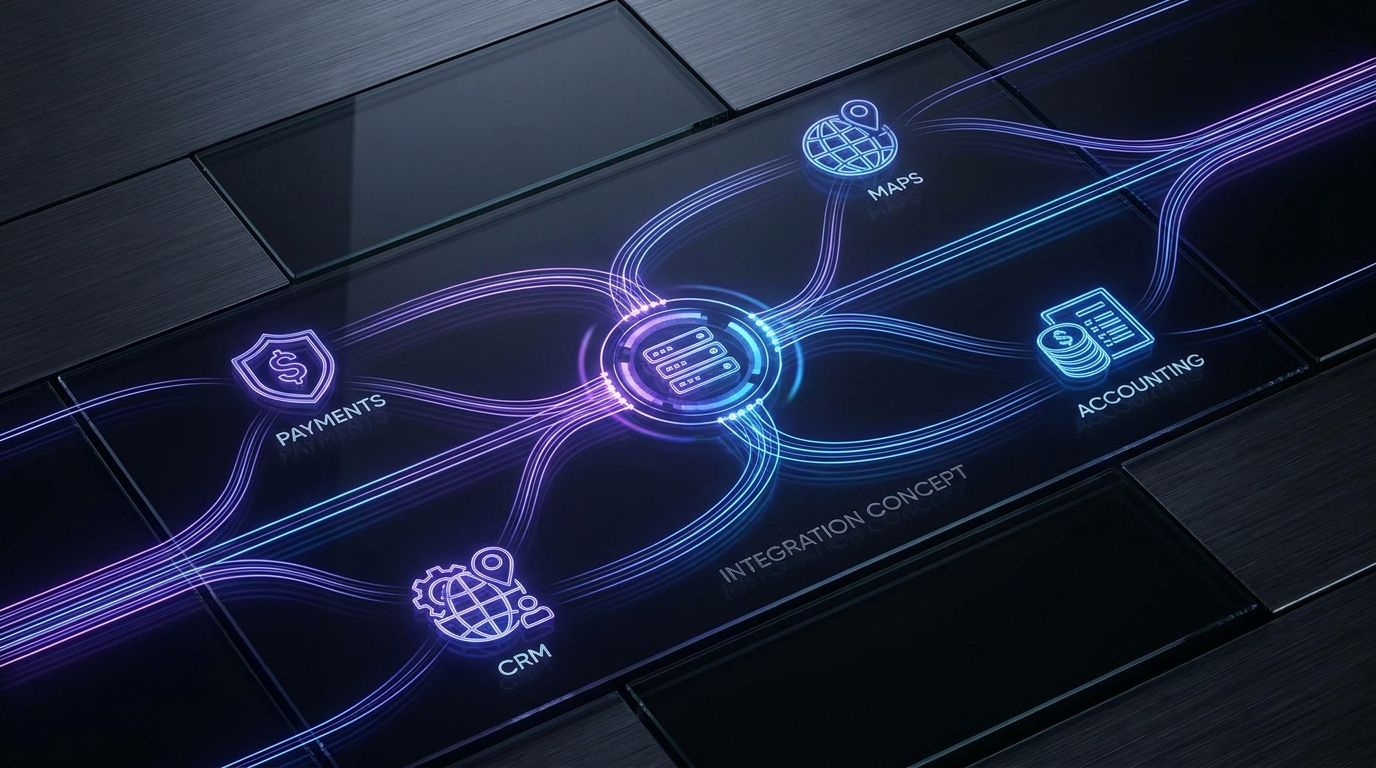
Across projects, the same handful of connections come up again and again. Here's what a typical UAE business ends up wiring together.
Payment gateways
Payment gateway integration in the UAE is the one I'm asked about most. Beyond global providers like Stripe, PayPal, and Checkout.com, local businesses need Telr, PayTabs, Network International, Amazon Payment Services, and Tabby or Tamara for buy-now-pay-later. Each has its own API quirks, currency handling, and settlement rules. Getting AED, refunds, and partial captures right is not optional — it's money.
CRM systems
As a crm integration developer, I connect stores and lead forms to HubSpot, Salesforce, Zoho, or Pipedrive so that every enquiry and purchase becomes a contact with full history. Sales teams stop working from spreadsheets, and marketing finally gets clean attribution.
Maps and location services
Google Maps and Mapbox power address autocomplete, delivery-zone checks, distance-based pricing, and driver tracking. For any UAE delivery business, accurate address validation alone reduces failed deliveries dramatically.
Accounting
Xero, QuickBooks, and Zoho Books integrations push invoices and payments straight from your store or CRM into the books. This is where FTA-compliant VAT reporting stops being a monthly panic.
WhatsApp and messaging
The WhatsApp Business API is huge in this region. I use it for order confirmations, delivery updates, and abandoned-cart nudges — sent automatically the moment an event happens in another system.
Shipping and logistics
Aramex, DHL, and local couriers expose APIs for rate calculation, label printing, and tracking. A good third party api integration here means a customer gets a tracking link automatically the instant a courier scans the parcel.
What a clean integration actually contains
Anyone can call an API once and get a demo working. The difference between that and a production integration is everything that handles the real world going wrong. Here's what I insist on building in.
Secure authentication
API keys and OAuth tokens never live in front-end code or a Git repository. They sit in a secrets manager or environment variables, are rotated on a schedule, and are scoped to the minimum permission the integration needs. Token refresh is handled automatically so nothing breaks at renewal time.
Robust error handling and retries
Third-party APIs go down, rate-limit you, and return odd responses. A serious integration retries with exponential backoff, distinguishes between a temporary failure and a permanent one, and never silently swallows an error. A payment that fails should be visible and recoverable, not lost.
Webhooks versus polling
You can either ask an API repeatedly "anything new yet?" (polling) or have it notify you the moment something changes (webhooks). Webhooks are faster and cheaper when the provider supports them; polling is the fallback when they don't. I choose per-endpoint based on latency needs and rate limits, and always verify webhook signatures so nobody can forge events.
Queues and background jobs
Integrations should never make a customer wait while your server talks to five external services. I push that work onto a queue (Redis, SQS, or Laravel's queue) so the user gets an instant response and the heavy lifting happens in the background — with automatic retries if a downstream service is slow.
Logging and observability
Every outbound call and inbound webhook is logged with enough detail to answer "what happened to order 4471?" months later. Structured logs, alerting on failure rates, and an audit trail turn a black box into something you can actually operate and trust.
Idempotency keys so a retried request never charges a customer twice.
Data validation and mapping between systems that name the same field differently.
A dead-letter queue for events that fail repeatedly, so nothing vanishes.
Monitoring dashboards and alerts so you hear about a broken pipe from me, not from an angry customer.
REST versus webhooks: when to use which
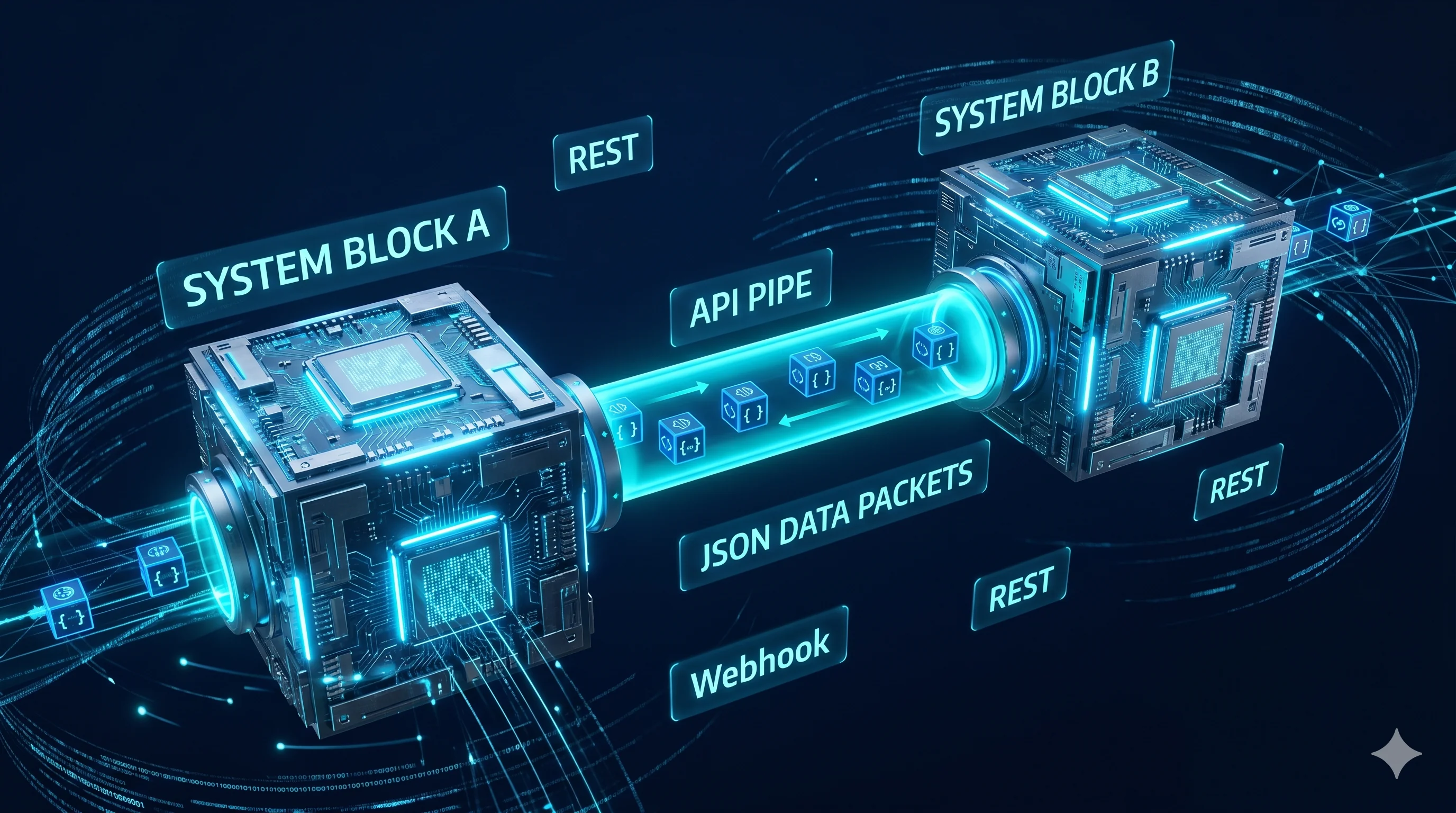
These aren't competitors — they solve different halves of the problem. REST is how you ask a system to do something: create an order, fetch a customer, issue a refund. It's request-and-response, initiated by you, and perfect when you need data on demand.
Webhooks are how a system tells you something changed, without you asking. A payment settles, a shipment moves, a subscription renews — the provider pushes that event to your endpoint in real time. A mature integration uses both: REST for reads and commands you initiate, webhooks for events you need to react to instantly. Relying on polling alone wastes API quota and adds delay; relying on webhooks alone leaves you blind if a delivery is missed, which is why I pair webhooks with a periodic reconciliation job that catches anything dropped.
Security and compliance in the UAE
Money and personal data raise the stakes. When I build integrations that touch payments or customer records, several things are non-negotiable:
PCI DSS — card data is never stored on your servers. I use hosted fields and tokenisation so sensitive numbers go straight to the gateway, keeping your PCI scope minimal.
Data protection — the UAE's PDPL and, for anyone serving EU customers, GDPR govern how personal data is handled, stored, and transferred. Integrations must respect consent and data-residency requirements.
Encryption everywhere — TLS in transit, encryption at rest for anything sensitive, and signed webhooks to prove events are genuine.
Least privilege — each integration gets only the API scopes it truly needs, so a leaked key can't be used to drain an entire account.
These aren't add-ons I bolt on at the end. They shape the architecture from the first line of code, which is exactly why a custom api integration developer who understands both engineering and regional compliance is worth the investment.
What drives the cost of an integration
Clients always ask for a single number, and the honest answer is "it depends on these factors." Understanding them helps you scope sensibly:
Number of systems — connecting two tools is straightforward; connecting six with data flowing in every direction is a project.
API quality — a well-documented modern REST API with webhooks is quick; a legacy SOAP API with no sandbox eats days.
Data complexity — simple field mapping is cheap; reconciling mismatched product catalogues or currencies is not.
Real-time versus batch — instant sync with queues and webhooks costs more to build than a nightly export.
Volume — an integration handling ten orders a day is engineered differently from one handling ten thousand.
Compliance scope — payments and health or financial data demand extra security work.
If you're weighing integration against building something larger, my breakdown of what a custom Laravel web app costs in Dubai gives useful context on how scope translates into budget.
Signs of a bad integration
I'm often brought in to fix integrations someone else built cheaply. The symptoms are consistent, and you can spot them without being technical:
Orders or leads that "sometimes" don't show up in your CRM or accounting.
Duplicate charges, duplicate contacts, or duplicate invoices appearing at random.
No logs — when something breaks, nobody can say what happened or why.
API keys hardcoded in the site's source, or shared across unrelated services.
The whole site slows to a crawl whenever a third-party service is having a bad day.
Manual "clean-up" tasks that someone runs every morning to patch the gaps.
Every one of these traces back to a missing fundamental — no retries, no idempotency, no queue, no logging. They're cheap to skip and expensive to live with.
A real example: store, gateway, CRM and WhatsApp
A Dubai retailer came to me with a familiar mess. Their WooCommerce store took payments through a UAE gateway, but every order was manually copied into their CRM, invoices were typed into their accounting software by hand, and customers were messaged one by one on WhatsApp. Two staff spent hours a day on it, and orders still slipped through.
I built a single integration layer that sat between all four systems. When a customer checks out, the payment is captured through the gateway with idempotency protection so a retry never double-charges. A signed webhook confirms settlement and triggers three background jobs on a queue: the order is created in the CRM as a contact with full history, a VAT-compliant invoice is pushed to their accounting software, and a WhatsApp confirmation with a live tracking link goes out automatically. Every step is logged, and a nightly reconciliation job cross-checks the gateway against the CRM to catch any dropped webhook.
The result: the manual copying disappeared entirely, order errors dropped to near zero, and the two staff moved to actual customer service. That's what a properly engineered third party api integration delivers — not a feature, but hours of your week back and a business you can trust the numbers of.
Key takeaways
Most businesses need their existing tools connected, not replaced — integration is cheaper and lower-risk than a rebuild.
The common connections are payments, CRM, maps, accounting, WhatsApp, and shipping.
A production integration needs secure auth, retries, webhooks or polling, queues, and thorough logging — the demo is the easy 10%.
Use REST for commands you initiate and webhooks for events you must react to instantly; reconcile to catch what's missed.
Payments and personal data bring PCI DSS, PDPL, and GDPR obligations that must shape the design from day one.
Bad integrations reveal themselves through missing records, duplicates, no logs, and daily manual clean-up.
Frequently asked questions
How long does a custom API integration take to build?
A single, well-documented connection such as a payment gateway typically takes a few days to a couple of weeks including testing. Multi-system integrations with real-time sync, queues, and reconciliation run longer. The API's quality and your data complexity are the biggest drivers of the timeline.
Which payment gateways can you integrate in the UAE?
I work with global providers like Stripe, PayPal, and Checkout.com, and local options including Telr, PayTabs, Network International, Amazon Payment Services, and buy-now-pay-later services like Tabby and Tamara. Each handles AED, refunds, and settlement differently, and I configure the right one for your business.
What is the difference between REST and webhooks?
REST is how your system asks another system to do something on demand — fetch data or create a record. Webhooks are how an external system notifies you the instant something changes, without you asking. A robust integration uses both: REST for commands and webhooks for real-time events.
Is my customer and payment data safe during integration?
Yes. Card data is tokenised so it never touches your servers, keeping PCI scope minimal. All traffic is encrypted, webhooks are signature-verified, API keys are stored in a secrets manager with least-privilege scopes, and the design respects UAE PDPL and, where relevant, GDPR.
Can you connect my CRM to my online store?
Absolutely — this is one of the most common jobs I do as a crm integration developer. I connect Shopify, WooCommerce, or custom stores to HubSpot, Salesforce, Zoho, or Pipedrive so every order and enquiry becomes a contact with full purchase history, automatically and in real time.
Can you fix an existing integration that keeps breaking?
Often, yes. Most failing integrations lack retries, idempotency, queues, or logging. I audit what's there, add the missing fundamentals, and put monitoring in place so you find out about problems from an alert rather than from a customer complaint.
Let's connect your systems the right way
If your team is copying data between tools, chasing missing orders, or dreading the next payment reconciliation, integration is almost certainly the fix — and a far better investment than replacing software that already works. I build integrations that are secure, observable, and quiet, the kind you forget are even there. I also handle larger builds when needed, including custom CRM development for UK businesses.
I'm Anas Tanveer, a freelance full-stack developer based in Dubai. If you'd like your payments, CRM, maps, accounting, and messaging tools working together automatically, get in touch and tell me what your systems are doing manually today — I'll show you what a clean integration would look like.
Practical checklist
Most businesses need their existing tools connected, not replaced — integration is cheaper and lower-risk than a rebuild.
The common connections are payments, CRM, maps, accounting, WhatsApp, and shipping.
A production integration needs secure auth, retries, webhooks or polling, queues, and thorough logging — the demo is the easy 10%.
Use REST for commands you initiate and webhooks for events you must react to instantly; reconcile to catch what's missed.
Payments and personal data bring PCI DSS, PDPL, and GDPR obligations that must shape the design from day one.
Bad integrations reveal themselves through missing records, duplicates, no logs, and daily manual clean-up.
How to turn this into a real project decision
Start by writing the business problem in one line. For example: the website is slow, the Shopify product page is confusing, the WordPress site does not generate quality leads, or the Laravel dashboard cannot support the workflow anymore. A clear problem statement makes the technical decision easier.
Next, separate the requirement into user experience, backend logic, SEO, speed, integrations and content. This prevents the common mistake of redesigning a page when the real issue is data structure, plugin conflict, weak copy, poor mobile UX or missing automation.
For Dubai, UAE and international clients, the strongest web solution is usually the one that improves trust, reduces manual work, loads fast on mobile and gives visitors a clear reason to contact the business. That is the standard I use when planning Laravel, WordPress, Shopify, ecommerce, dashboard and SEO-focused work.
FAQs
What does a custom API integration developer do?
A custom API integration developer connects separate tools so data moves automatically between payments, CRM, ecommerce, maps, accounting, shipping or internal systems without manual copy-paste.
What makes API integrations fail?
Weak integrations fail because they ignore authentication, retries, webhooks, rate limits, logging, validation and edge cases. A reliable integration is designed for failure, not just the happy path.
Are APIs secure for payments and customer data?
They can be secure when built with proper authentication, encryption, least-privilege access, audit logs, validation and careful handling of secrets. Security must be part of the integration scope from day one.
Can you integrate UAE payment gateways and CRMs?
Yes. I can connect payment gateways, CRMs, maps, ecommerce stores and internal dashboards for Dubai and UAE businesses using secure API and webhook architecture.
Ready to discuss this?
Send your website URL, platform, issue and goal — I'll reply with a practical direction within 4 hours. Free 20-min discovery call available.
Message on WhatsApp — Free 20-min callRelated service
Looking for hands-on help with this?
API Integration ServicesRelated services
Need help applying this to your project?

Anas Tanveer
Full-Stack Developer in Dubai with 7+ years in Laravel, WordPress, Shopify, business dashboards, APIs, and SEO-ready web systems.
View profile