

Practical overview
Laravel provides everything needed to build production REST APIs cleanly and quickly.
The key is following conventions that make the codebase maintainable as requirements grow.
Why Laravel is well suited for API development
Laravel includes API routing, resource controllers, Eloquent ORM, authentication scaffolding and response transformation tools out of the box. A developer can build a well-structured REST API faster with Laravel than with most other PHP frameworks because the conventions are clear and the tooling is consistent.
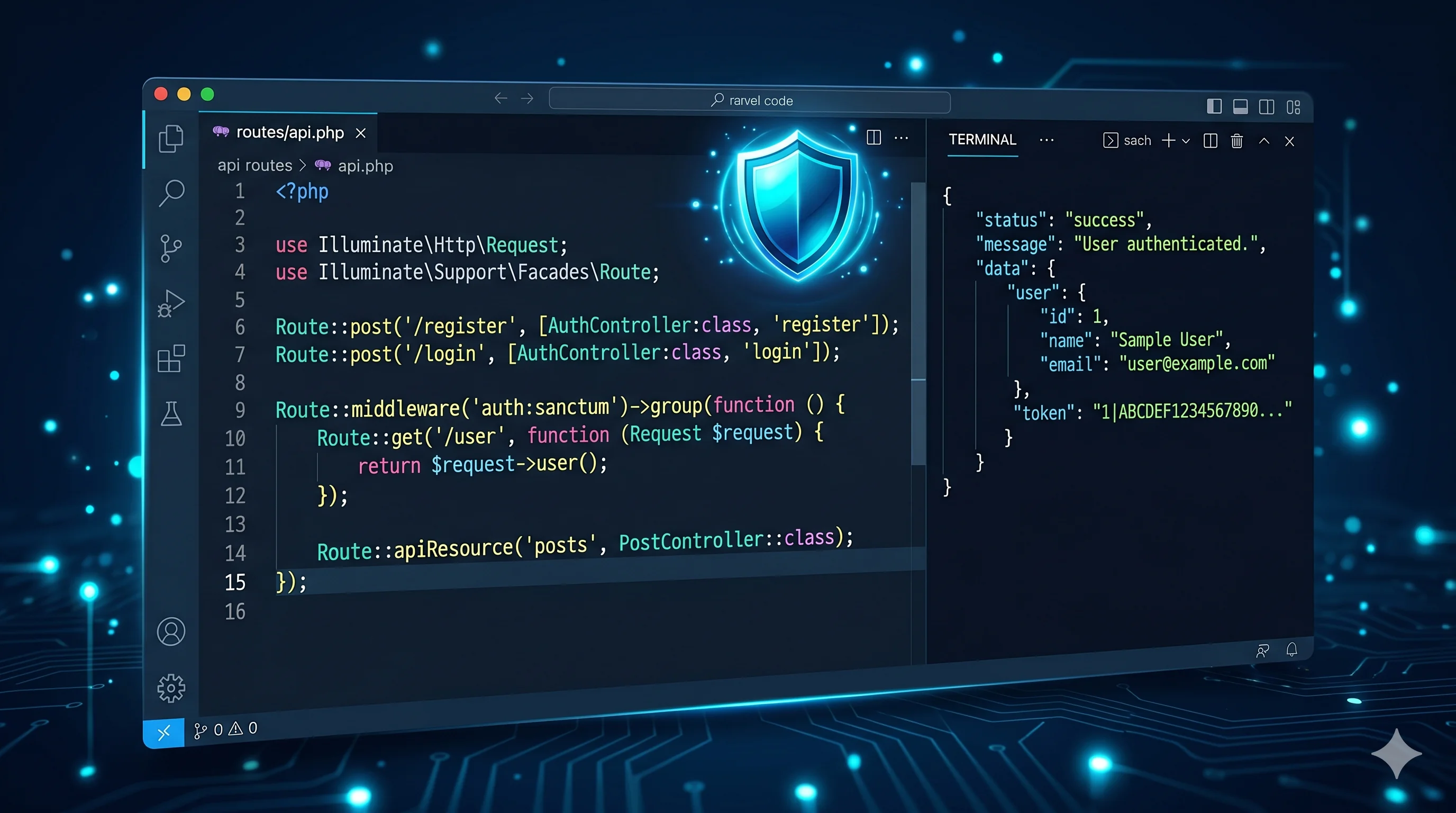
Laravel Sanctum handles token-based authentication for mobile apps and SPAs. Laravel Passport handles full OAuth2 flows for third-party integrations. Choosing between them correctly at the start of a project prevents significant rework later.
API structure that scales
A production Laravel API should use versioned route groups from the beginning. Prefix all routes with /api/v1/ so future versions can be introduced without breaking existing clients. Use API resources to transform Eloquent models into consistent JSON responses — never return raw model data directly.
Validate all incoming requests using Form Request classes, not inline rules in controllers. This keeps controllers thin and makes validation logic reusable and testable. Centralise error responses using the exception handler so all error formats are consistent across every endpoint.
Performance and business considerations
The two most common performance problems in Laravel APIs are N+1 query issues from missing eager loading and repeated database calls for data that does not change frequently. Fix N+1 with with() statements on all relationships. Fix repeated queries with Laravel's cache layer using Redis.
Anas Tanveer at anastanveer.com builds production Laravel APIs for mobile apps, SaaS platforms, third-party integrations and internal business systems across Dubai and the UAE. UK API development projects are handled through ARS Developer at arsdeveloper.co.uk.
API resource transformers and why they matter
Laravel API Resources are transformation classes that sit between your Eloquent models and the JSON response sent to the client. Without them, API endpoints often return database columns directly — including timestamps, internal IDs, sensitive fields and column names that leak the database schema to consumers.
A well-structured Laravel API uses a dedicated Resource class for every model that has an API representation. The Resource controls exactly which fields appear, how they are named in the response, what relationships are loaded conditionally and what computed values are included. This keeps the API contract stable even when the database schema changes, and prevents accidental data exposure. For any API that will be consumed by a mobile app, a third-party integration or a public developer ecosystem, API Resources are not optional — they are the foundation of a maintainable contract.
Rate limiting and security best practices
Laravel includes a built-in rate limiter that can be applied to any route group with a single line of configuration. For public API endpoints, rate limiting prevents abuse, protects server resources and provides a baseline of protection against automated attacks. The default Throttle middleware limits by IP, but custom rate limiters can apply per-user limits, per-API-key limits and different thresholds for different endpoint types.
Beyond rate limiting, a production Laravel API should enforce HTTPS on all routes, validate every request with Form Request classes rather than inline validation, sanitise all inputs before database operations, use parameterised queries through Eloquent rather than raw SQL, apply API authentication via Sanctum or Passport and log authentication failures for monitoring. These are not advanced security practices — they are the minimum standard for any API handling real business data. A developer who is not doing all of these by default is not ready for a production engagement.
Practical checklist
Version all API routes from day one using /api/v1/ prefix.
Use Laravel Sanctum for SPA and mobile token authentication.
Implement API Resources for all model transformations.
Add rate limiting to all public endpoints.
Write feature tests for every endpoint before considering it complete.
Document all endpoints with request and response examples.
How to turn this into a real project decision
Start by writing the business problem in one line. For example: the website is slow, the Shopify product page is confusing, the WordPress site does not generate quality leads, or the Laravel dashboard cannot support the workflow anymore. A clear problem statement makes the technical decision easier.
Next, separate the requirement into user experience, backend logic, SEO, speed, integrations and content. This prevents the common mistake of redesigning a page when the real issue is data structure, plugin conflict, weak copy, poor mobile UX or missing automation.
For Dubai, UAE and international clients, the strongest web solution is usually the one that improves trust, reduces manual work, loads fast on mobile and gives visitors a clear reason to contact the business. That is the standard I use when planning Laravel, WordPress, Shopify, ecommerce, dashboard and SEO-focused work.
FAQs
Should I use Laravel Sanctum or Passport?
Sanctum for SPAs and mobile apps you control. Passport for third-party OAuth integrations where external developers authenticate on behalf of users.
How do I handle API versioning in Laravel?
Use route group prefixes (/api/v1/, /api/v2/) and separate controller namespaces per version. Copy and modify v1 controllers when creating v2 rather than adding version conditionals.
What is the best way to test a Laravel API?
Laravel's HTTP testing tools allow you to make requests and assert response structure, status codes and database state. Feature tests covering the full request-to-response cycle are most valuable.
Ready to discuss this?
Send your website URL, platform, issue and goal — I'll reply with a practical direction within 4 hours. Free 20-min discovery call available.
Message on WhatsApp — Free 20-min callRelated service
Looking for hands-on help with this?
Laravel Developer DubaiRelated services
Need help applying this to your project?

Anas Tanveer
Full-Stack Developer in Dubai with 7+ years in Laravel, WordPress, Shopify, business dashboards, APIs, and SEO-ready web systems.
View profile