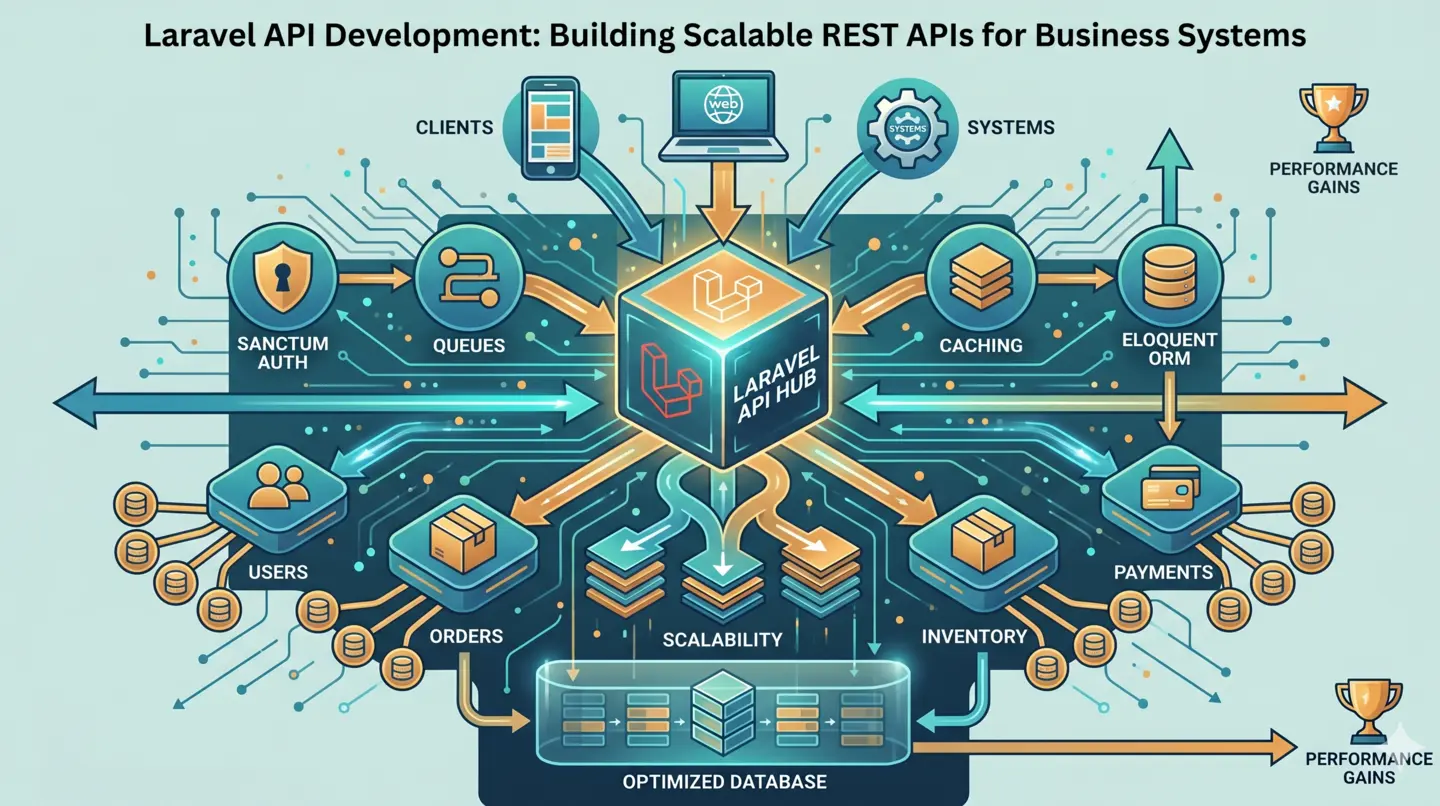

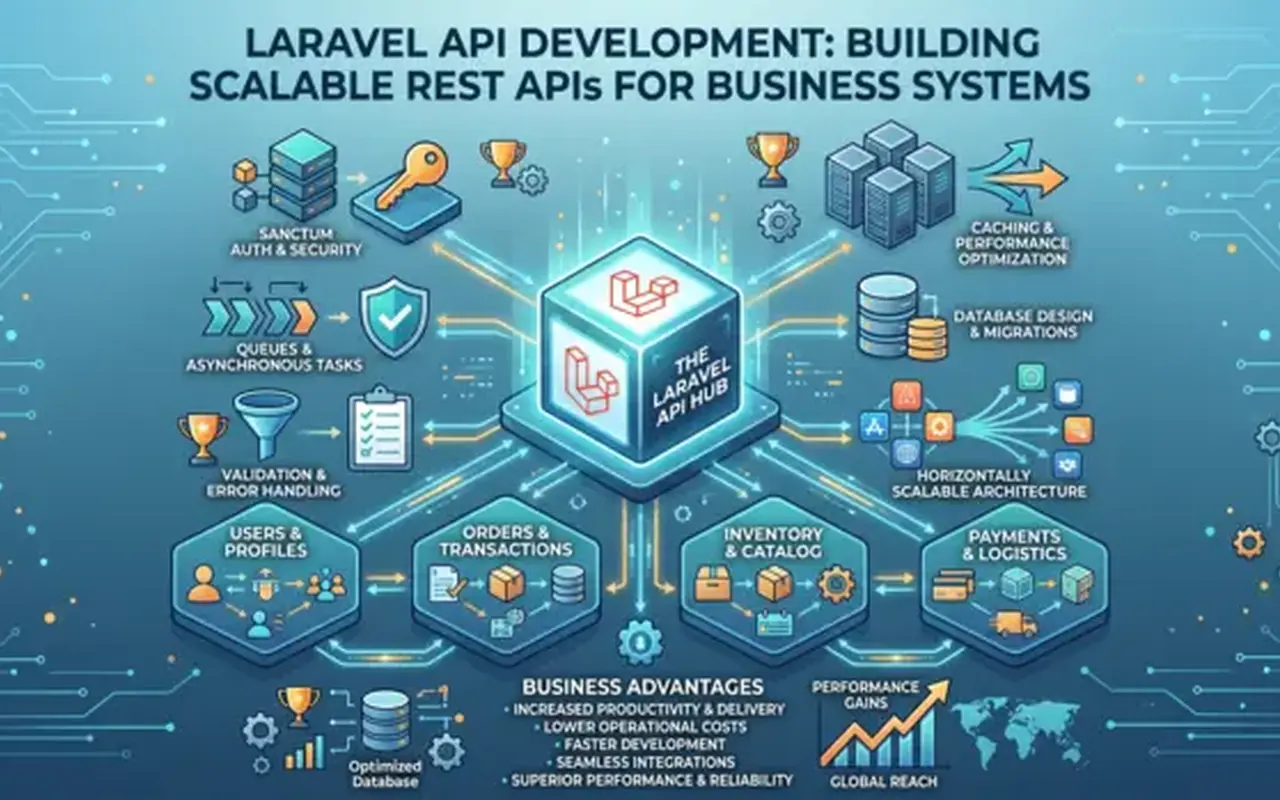
Practical overview
Canadian businesses hiring a full stack developer need to understand what the term actually means in 2024 — because it is used to describe everything from a junior WordPress generalist to a senior engineer delivering complex Laravel APIs with React frontends. The difference is significant in both quality and cost.
This guide covers what full stack development means for Canadian web projects, how CAD rates compare across Toronto, Vancouver, Calgary, and Ottawa, what to test before hiring, and how to structure an engagement that delivers on time and within budget.
What full-stack means for Canadian businesses
A full-stack developer builds the complete web application: Laravel backend (routing, database, authentication, APIs, queues), React or Next.js frontend (UI, state, data fetching, performance), and the connection between them. One developer is accountable for the entire application — no handoff between backend and frontend teams.
Canadian businesses choose a full-stack developer over two specialists when the project has a single developer scope: a custom dashboard, a SaaS MVP, a client portal, or a business application below CAD 50,000 that does not require parallel development streams. Two specialists create coordination overhead without delivering proportionally better quality for these project sizes.
The most productive Canadian full-stack combination is Laravel (PHP) for the backend and React/Next.js for the frontend. Laravel provides a robust, tested backend framework with strong Canadian developer supply; React provides a mature, component-based frontend ecosystem with TypeScript support.
What to test when hiring a Canadian full-stack developer
Test the backend independently. Ask for a Laravel project example with clean service classes, proper Eloquent relationships, Form Request validation, and feature tests. Developers who write everything in controllers are not senior backend engineers regardless of claimed experience.
Test the frontend independently. Ask for a React or Next.js project with TypeScript, proper component architecture, React Query or SWR for data fetching, and clean state management. Developers who use class components, avoid TypeScript, and manage all state in a single top-level component are not senior frontend engineers.
Test the integration. Ask how they structure the API contract between Laravel and React — how they handle authentication (Sanctum vs Passport), how they manage loading and error states on the frontend, and how they test API endpoints. The integration point is where full-stack projects typically fail — test it explicitly.
Canadian full-stack developer rates in CAD
Junior full-stack developers in Canada charge CAD 50–75/hour. They can build basic CRUD applications but struggle with authentication, complex data relationships, and performance optimisation. Mid-level full-stack developers charge CAD 75–110/hour with real production experience.
Senior Canadian full-stack developers with 5+ years of Laravel and React experience charge CAD 110–160/hour. They architect systems correctly, write tests, handle performance and security, and manage projects without daily oversight. Toronto and Vancouver agencies with full-stack capacity charge CAD 150–250/hour with PM overhead.
For projects with a defined scope (a dashboard, a SaaS platform, a client portal), a senior remote Canadian full-stack developer at CAD 110–130/hour typically delivers better total cost-to-quality ratio than a Toronto agency at CAD 180/hour.
What full stack means for Canadian web projects in 2024
A full stack developer for Canadian business projects typically means: a backend developer who can build Laravel or Node.js APIs, configure databases, manage authentication, and write clean server-side business logic — combined with a frontend developer who can build React or Next.js interfaces, integrate APIs, and deliver production-ready UIs. That combination is valuable because it eliminates the coordination cost between two separate specialists.
Canadian SaaS companies and growing tech-forward businesses in Toronto and Vancouver typically require the highest full stack competence level — Laravel or Node.js API architecture, React/Next.js frontend, PostgreSQL or MySQL database design, AWS or DigitalOcean deployment, and third-party API integration (Stripe, Twilio, SendGrid, Shopify API). These are enterprise-adjacent skill requirements that command CAD 80–130/hour in the Canadian market.
Canadian small and medium businesses outside the major metros — Calgary, Ottawa, Edmonton, Winnipeg — typically need full stack developers for business websites with custom backend features: quote forms with database storage, client portals, inventory tracking, or WooCommerce with custom product logic. These projects are less architecturally complex and are well-served by developers at CAD 50–80/hour.
Full stack developer rates across Canadian cities
Toronto full stack developer freelance rates range from CAD 75–130/hour for senior developers with Laravel/React or Node.js/React experience. Toronto commands the highest rates in Canada — driven by proximity to Bay Street financial clients, enterprise tech companies, and the highest cost of living in Canada.
Vancouver full stack developer rates run CAD 70–120/hour for senior full stack work. Vancouver's strong tech sector (Electronic Arts, Hootsuite, Slack's original team) means sophisticated clients and competitive developer rates. Calgary and Edmonton full stack rates are CAD 55–95/hour — the energy sector generates high-budget custom web application projects but the developer pool is smaller than Toronto or Vancouver.
Ottawa full stack rates range from CAD 60–110/hour. Ottawa's government and federal contractor ecosystem drives demand for developers with security clearance or experience with government web standards. Montreal full stack rates are CAD 55–100/hour — Quebec's bilingual requirement adds scope to any public-facing application.
How to evaluate a full stack developer before hiring in Canada
The most reliable test for full stack competence is a paid trial task: ask the candidate to build a simple CRUD application — a task management tool, a contact form with database storage, or a simple inventory list — using their preferred stack, with authentication, input validation, and a React frontend consuming the API. A senior full stack developer completes this in 4–6 hours and produces code that is readable, structured, and secure. This single test reveals more than ten portfolio conversations.
For Canadian businesses specifically: ask about Canadian-specific experience. Have they configured Stripe Canada with GST/HST/PST calculations? Have they worked with Canadian payment processors (Moneris, Bambora)? Do they understand CASL compliance for email marketing integration? Do they know provincial tax rules (QST for Quebec, PST for British Columbia, no PST in Alberta)? These questions separate developers with Canadian client experience from those who have not worked in the Canadian market.
Check their approach to web accessibility — WCAG 2.1 AA compliance is a legal requirement for federally regulated Canadian organisations and is increasingly expected in provincial government and public sector projects. Full stack developers building for Canadian government or crown corporation clients must understand accessibility requirements. Ask how they test accessibility: a developer who cannot name specific testing tools (axe, NVDA, VoiceOver) has not worked on compliant Canadian public-sector projects.
Practical checklist
Define whether you need Laravel/PHP, Node.js, or a different backend stack before interviewing.
Specify React, Next.js, Vue, or plain TypeScript on the frontend before writing the job brief.
Ask specifically about Canadian tax (GST/HST/PST) configuration if ecommerce is involved.
Ask about CASL compliance if the project includes email marketing or user communications.
Run a paid trial task — 4 hours — before committing to a full engagement.
Confirm CAD rate, payment currency, invoicing, and whether they are a registered Canadian business.
Agree milestone-based payment: 30% deposit, milestone payments, final on delivery.
Confirm post-launch support terms and bug fix responsibility window.
How to turn this into a real project decision
Start by writing the business problem in one line. For example: the website is slow, the Shopify product page is confusing, the WordPress site does not generate quality leads, or the Laravel dashboard cannot support the workflow anymore. A clear problem statement makes the technical decision easier.
Next, separate the requirement into user experience, backend logic, SEO, speed, integrations and content. This prevents the common mistake of redesigning a page when the real issue is data structure, plugin conflict, weak copy, poor mobile UX or missing automation.
For Dubai, UAE and international clients, the strongest web solution is usually the one that improves trust, reduces manual work, loads fast on mobile and gives visitors a clear reason to contact the business. That is the standard I use when planning Laravel, WordPress, Shopify, ecommerce, dashboard and SEO-focused work.
FAQs
What do full stack developer rates look like in Canada?
Senior full stack developer rates in Canada range from CAD 55–130/hour depending on city and experience. Toronto and Vancouver command the highest rates (CAD 70–130/hour). Calgary, Ottawa, Edmonton, and Montreal range from CAD 55–110/hour.
What stack do most Canadian full stack developers use?
The most common full stack combinations in Canada are: Laravel + React/Next.js (strong in Toronto and Vancouver agencies), Node.js + React (common in SaaS companies), and WordPress/WooCommerce + React (for SMB projects). Laravel + React is the strongest combination for custom business applications.
Do Canadian full stack developers need to know about GST/HST/PST?
Yes — any developer building a Canadian ecommerce or billing system needs to understand Canadian tax: GST (5% federal), HST (combined in Ontario, Nova Scotia, New Brunswick, PEI, Newfoundland), PST (British Columbia, Saskatchewan), and QST (Quebec). Tax misconfiguration on a Canadian ecommerce site creates CRA compliance risk.
Ready to discuss this?
Send your website URL, platform, issue and goal — I'll reply with a practical direction within 4 hours. Free 20-min discovery call available.
Message on WhatsApp — Free 20-min callRelated service
Looking for hands-on help with this?
Hire a Web Developer — UAERelated services
Need help applying this to your project?

Anas Tanveer
Full-Stack Developer in Dubai with 7+ years in Laravel, WordPress, Shopify, business dashboards, APIs, and SEO-ready web systems.
View profile