
Why almost every UAE business starts with spreadsheets
There is no shame in starting with Excel or Google Sheets. They are nearly free, everyone knows how to use them, and you can build a working "system" in an afternoon. When you are a team of three tracking a few dozen orders a month, a spreadsheet is the right tool. It is fast, flexible, and you do not need a developer to add a column.
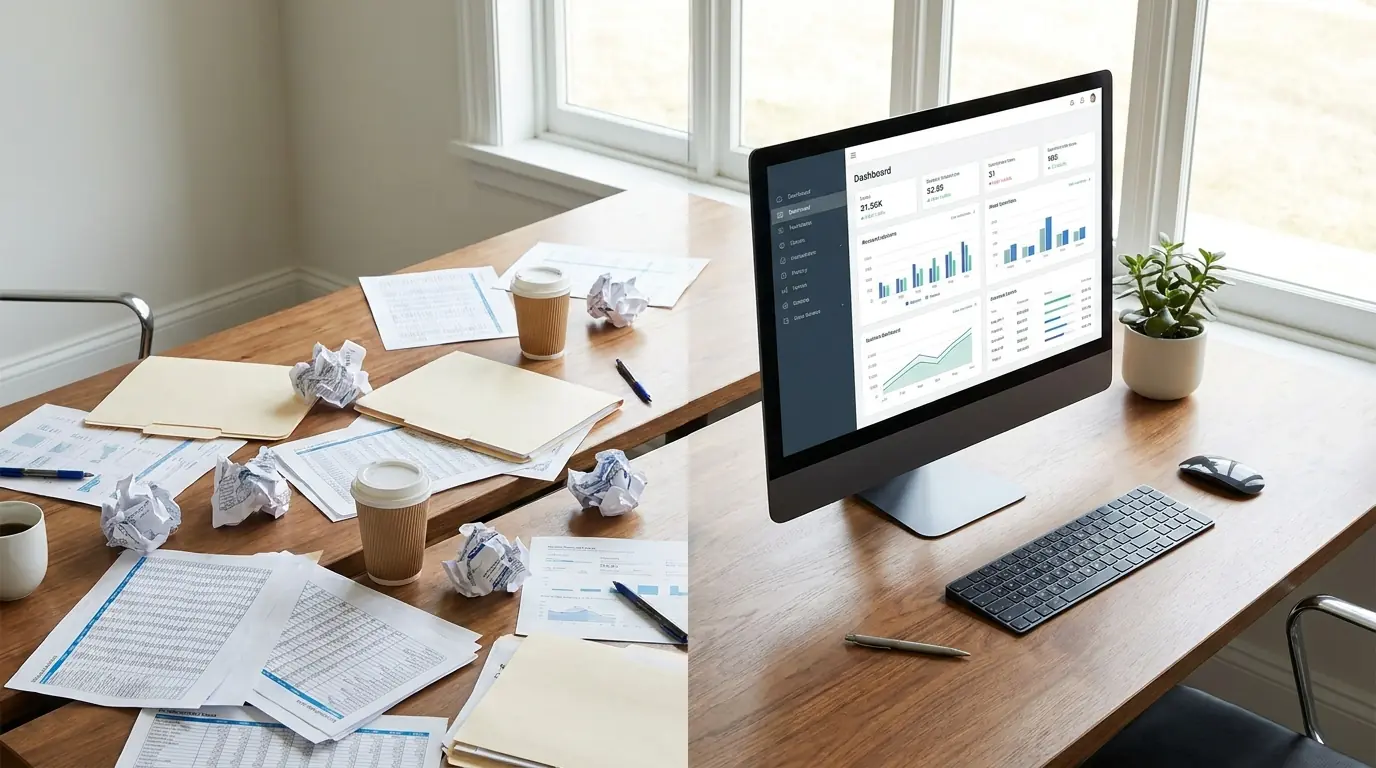
The problem is that spreadsheets scale with effort while your business scales with complexity. What worked at three people and fifty transactions cracks at fifteen people and two thousand transactions. By then the spreadsheet is not a convenience. It is a liability everyone is afraid to touch, and the point where a custom ERP for small business UAE teams can actually rely on starts to make sense.
The hidden costs of running your business on spreadsheets
When I audit a client's spreadsheet-based operation, I am not looking at the file. I am looking at what the file is costing them. These costs are real money, but they rarely show up on any invoice, so most owners never notice them piling up.
Silent errors. A single wrong cell reference, a dragged-down formula, or a typo in a VLOOKUP can throw off a whole month of numbers. Nobody gets an alert. You find out when a customer disputes an invoice or the VAT figures do not add up.
No audit trail. Who changed that price? When? Why? In a shared spreadsheet, the answer is almost always "nobody knows." There is no record of who did what, which is a serious problem during an FTA audit or a dispute.
Key-person risk. Every spreadsheet-run business has one person who "understands the file." If that person leaves, goes on holiday, or simply gets sick, the whole operation slows to a crawl. You have built your company on knowledge that lives in one head.
Wasted hours. Copy-pasting between tabs, reconciling two versions someone emailed around, manually building the same monthly report. I have seen teams burn ten to fifteen hours a week on work a system would do instantly.
No real-time reporting. By the time you have cleaned the data and built the chart, the number is already a week old. You are steering the business by looking in the rear-view mirror.
Version chaos. "final_v3_USE_THIS_ONE.xlsx" is a meme because it is true. Multiple copies mean multiple sources of truth, which means no source of truth at all.
Add these up and a "free" spreadsheet often costs a growing UAE business tens of thousands of dirhams a year in lost time, errors, and missed decisions. That is the framing that matters when you weigh up erp development Dubai work against staying put.
The clear signs it is time to move from spreadsheets to ERP
You do not need to migrate the moment you outgrow a single tab. But there are concrete signals that tell me a client is ready. If three or more of these sound familiar, it is time to seriously plan to move from spreadsheets to ERP and consider a custom ERP for small business UAE use:
You have more than one spreadsheet that has to stay "in sync," and keeping them in sync is now a job.
Two people have edited the same file and overwritten each other's work.
You cannot answer a simple question ("how much did we sell to Client X this quarter?") without ten minutes of filtering.
You are manually re-keying the same data into your accounting software, your invoices, and your reports.
You are nervous every time someone opens the file because one wrong move could break a formula.
You need to control who can see or change what, and a spreadsheet simply cannot enforce that.
Your VAT or compliance reporting is a painful, error-prone scramble at the end of every period.
What a custom ERP or dashboard actually gives you
People hear "ERP" and picture a six-month SAP nightmare. That is not what most UAE SMEs need. A focused custom system, often built as a clean web app, gives you a few things a spreadsheet structurally cannot:
Clean, validated data. The system enforces the rules. You cannot enter a negative quantity or a date that does not exist, because the form will not let you. Bad data never enters in the first place.
Roles and permissions. Your sales team sees sales, your accountant sees finance, your warehouse sees stock. Each person sees and edits only what they should.
Automation. Invoices generate themselves, stock deducts on dispatch, low-balance alerts fire automatically. The repetitive work that ate your team's week just disappears.
Real-time reporting. A live dashboard shows today's numbers, not last week's. You make decisions on facts, not a stale snapshot.
A full audit trail. Every change is logged with who, what, and when. Compliance and disputes stop being stressful.
This is where a good business dashboard developer UAE earns their fee: not by building something fancy, but by turning a chaotic, fragile file into a calm, reliable single source of truth.
ERP vs custom dashboard vs off-the-shelf software
This is the question I get asked most, so let me be plain about the three options.
Off-the-shelf software
Tools like Zoho, Odoo, or QuickBooks are excellent when your processes are standard. They are cheap to start and quick to deploy. The catch: you have to bend your business to fit the software. If your workflow is unusual, you end up paying for features you do not use while still falling back on spreadsheets for the parts the tool does not cover.
Custom dashboard
A custom dashboard sits on top of your existing data and gives you reporting, visibility, and light data entry. It is the fastest, cheapest way to kill the "I cannot see my numbers" problem. It is a great first step when your core operations are not yet broken, just invisible.
Custom ERP
A custom ERP runs the operation itself: orders, inventory, invoicing, customers, finance, all in one place, built exactly around how you actually work. This is the right call when your processes are specific to your industry and off-the-shelf tools force ugly compromises. It costs more upfront, but it fits like a tailored suit. For many of my clients, the path is a a custom Laravel web app that starts as a focused module and grows into a full ERP over time.
A real example: a fuel-distribution ERP that replaced spreadsheets
One of the clearest cases I have worked on was a fuel-distribution business in the UAE. Their entire operation ran on a chain of linked spreadsheets: one for orders, one for deliveries, one for customer credit balances, one for driver schedules. Each morning someone spent two hours reconciling yesterday's deliveries against orders and updating credit limits by hand.
The pain points were textbook. Drivers were dispatched to customers who had already blown past their credit limit, because the credit file was a day behind. Staff overwrote each other's delivery logs. And when the owner wanted to know which customers were most profitable, it took half a day to produce a number nobody fully trusted.
We replaced the whole stack with a focused custom ERP for small business UAE operations. Orders, deliveries, credit control, and driver scheduling now live in one system. The moment an order is placed, the system checks the customer's live credit balance and blocks dispatch if they are over the limit. Deliveries update stock and customer balances automatically. The owner opens a dashboard and sees real-time profitability per customer, per route, per driver.
The result: that two-hour morning reconciliation dropped to about ten minutes of review. Credit-related losses effectively stopped. And the key-person risk vanished, because the rules now live in the system, not in one employee's memory. That is the practical promise of good erp development Dubai work, not a flashy interface, but hours and risk removed from the business every single day.
Cost and ROI: how to think about the investment
The honest answer to "what does it cost" is "it depends on scope," but here is a useful way to frame it.
Do not compare the project cost to zero, because your spreadsheet is not free. Compare it to what the spreadsheet costs you now. If your team wastes twelve hours a week on manual reconciliation and reporting, that is roughly 600 hours a year. Put even a modest hourly value on that and you have a large, recurring, invisible bill. A custom system that removes most of those hours often pays for itself within the first year, and keeps paying every year after.
A custom dashboard is the lightest investment and the fastest payback, often visible within weeks.
A starter ERP module (one workflow, done properly) is a mid-range investment that targets your single biggest pain point.
A full custom ERP is the largest investment but delivers the deepest return, because it removes whole categories of manual work and risk at once.
The mistake I see is owners fixating on the upfront figure while ignoring the recurring cost of staying on spreadsheets. The right question is not "what does this cost?" but "what is the spreadsheet already costing me, and how long until a system pays for itself?"
How to start small: one workflow first
The best advice I give anyone considering this move is: do not replace everything at once. Big-bang ERP projects are where budgets and patience go to die. Instead, pick the one workflow causing the most pain and replace just that.
For the fuel-distribution client, that first workflow was credit control and dispatch, because that is where real money was leaking. Once that piece proved itself, expanding into inventory and reporting was easy and low-risk. Starting small means you see value quickly, your team adapts gradually, and you validate the approach before committing to a larger build. This is also how custom crm development Dubai projects usually succeed: start with the one process that hurts, prove it, then grow.
Implementation steps: how the process actually works
Map the real workflow. Before any code, I sit with your team and document how the work actually happens, not how the manual says it should.
Pick the first module. Choose the one process with the highest pain and clearest ROI to build first.
Design the data model. Get the structure of your customers, orders, and inventory right, because everything else is built on it.
Build, test, and migrate. Develop the module, test it against real data, then carefully migrate from the spreadsheet.
Train and roll out. Bring the team on gradually with hands-on training so adoption sticks.
Expand. Add the next workflow once the first is proven and stable.
Service-led businesses often pair the ERP with a client-facing layer too. If your customers need to log in, view their orders, or raise requests themselves, that is where customer portal development for service firms becomes the natural next step on top of the core system.
Conclusion
Spreadsheets get UAE businesses off the ground, and there is nothing wrong with that. But there comes a point where the file stops helping and starts holding you back, quietly draining hours, hiding errors, and putting your whole operation at the mercy of one person who "knows the file." When you reach that point, moving to a focused custom system is not a luxury. It is one of the highest-return decisions a growing business can make.
If your spreadsheet is starting to feel like a liability rather than a tool, let's talk. I help UAE businesses scope and build practical ERP, dashboard, and custom crm development Dubai solutions that start small, prove their value fast, and grow with you. Reach out through anastanveer.com and tell me about the workflow that is causing you the most pain, and we will figure out whether it is time to move.
Practical checklist
Spreadsheets are the right starting point, but they scale poorly and carry hidden costs: silent errors, no audit trail, key-person risk, and wasted hours.
If you are juggling multiple "synced" files, re-keying data, or struggling with simple reporting, it is time to plan a move.
A custom ERP for small business UAE gives you clean data, roles, automation, real-time reporting, and a full audit trail.
Off-the-shelf fits standard businesses; a custom dashboard adds visibility fast; a custom ERP fits businesses with specific workflows.
Frame cost against what the spreadsheet is already costing you, not against zero.
How to turn this into a real project decision
Start by writing the business problem in one line. For example: the website is slow, the Shopify product page is confusing, the WordPress site does not generate quality leads, or the Laravel dashboard cannot support the workflow anymore. A clear problem statement makes the technical decision easier.
Next, separate the requirement into user experience, backend logic, SEO, speed, integrations and content. This prevents the common mistake of redesigning a page when the real issue is data structure, plugin conflict, weak copy, poor mobile UX or missing automation.
For Dubai, UAE and international clients, the strongest web solution is usually the one that improves trust, reduces manual work, loads fast on mobile and gives visitors a clear reason to contact the business. That is the standard I use when planning Laravel, WordPress, Shopify, ecommerce, dashboard and SEO-focused work.
FAQs
What is the difference between an ERP and a dashboard?
A dashboard is for seeing your data: it pulls numbers together and shows you reports and charts in real time. An ERP is for running your business: it is where the work actually happens, where orders are created, stock is managed, and invoices are generated. A dashboard usually sits on top of an ERP or your existing data. Many clients start with a dashboard for visibility, then build out ERP functionality underneath it.
How much does a custom ERP cost in the UAE?
It depends entirely on scope. A focused single-workflow module is a fraction of the cost of a full multi-department system, which is why a custom ERP for small business UAE budget is usually more affordable than owners expect. Rather than quoting a number blind, I scope the first painful workflow, price that, and compare it to what your current manual process costs you each year. That comparison almost always makes the decision obvious.
When is a spreadsheet enough?
A spreadsheet is genuinely enough when your team is small, your transaction volume is low, only one or two people edit the data, and you are not depending on it for compliance or real-time decisions. If that describes you, do not over-engineer. Stay on the spreadsheet until you start hitting the warning signs in this article.
Can a custom system work alongside my accounting software?
Yes. A well-built custom ERP or CRM integrates with the tools you already use rather than replacing them. We can push data into your accounting system automatically, so you stop re-keying invoices and figures by hand. The goal is one source of truth feeding everything else.
How long does it take to move from spreadsheets to a custom system?
A single-workflow module can be live in a matter of weeks, not months, which is exactly why I recommend starting small. A full ERP build takes longer, but because we roll it out one workflow at a time, you start getting value from the very first module rather than waiting for the entire system to finish.
Ready to discuss this?
Send your website URL, platform, issue and goal — I'll reply with a practical direction within 4 hours. Free 20-min discovery call available.
Message on WhatsApp — Free 20-min callRelated services
Need help applying this to your project?

Anas Tanveer
Full-Stack Developer in Dubai with 7+ years in Laravel, WordPress, Shopify, business dashboards, APIs, and SEO-ready web systems.
View profile